


The summer of 2026 in the marketing world was marked by some unexpected wins for Out of Home (OOH) advertising and branding. The most notable of which being an act of unbranding that ultimately turned into a viral moment.
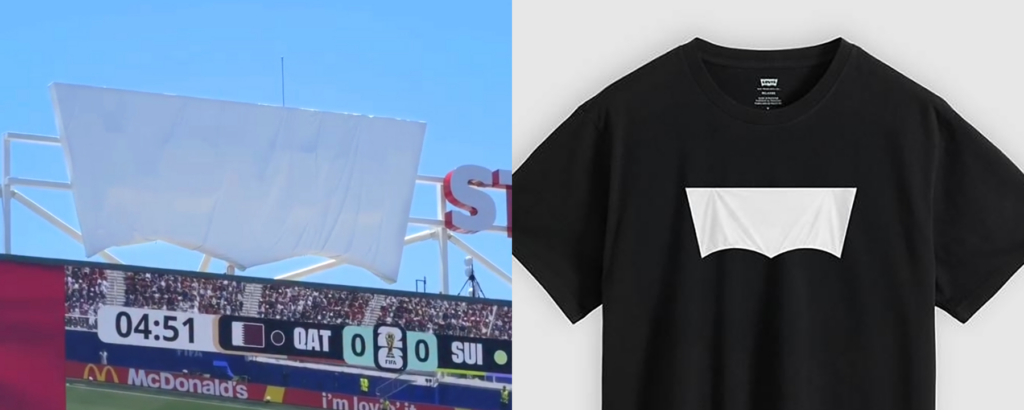
This, of course, was the white tarp-covered Levi’s logo in a World Cup stadium venue, which became a social media sensation and led to a sold-out run of unbranded Levi’s T-shirts. Although the logo was covered to comply with FIFA venue rules, the distinct shape of the Levi’s logo under a tarp sparked a massive global conversation in a humorous twist.
Today’s advertising landscape favors social media and PPC campaigns, but physical ad spaces are seeing a resurgence as the public craves IRL experiences.
Capturing attention in the spaces where people commute and congregate is still a valuable effort, but does it work for everyone? And how are successful OOH campaigns finding positive results?
Fueled by witty and engaging messaging, modern OOH strategies paired with enhanced technologies like AI are changing the game. Here is a look at what OOH is, who uses it, and how artificial intelligence and programmatic technology are shaping its future.
What exactly is OOH?
OOH includes any visual marketing or branding display placed in public environments to reach consumers while they are away from home. Typically, the target audiences are people driving (or riding as passengers), walking through city streets, shopping, traveling by bike or other personal transportation, or waiting for mass transit. They are people on the go and away from home, and whose attention can be captured by large-scale advertising.
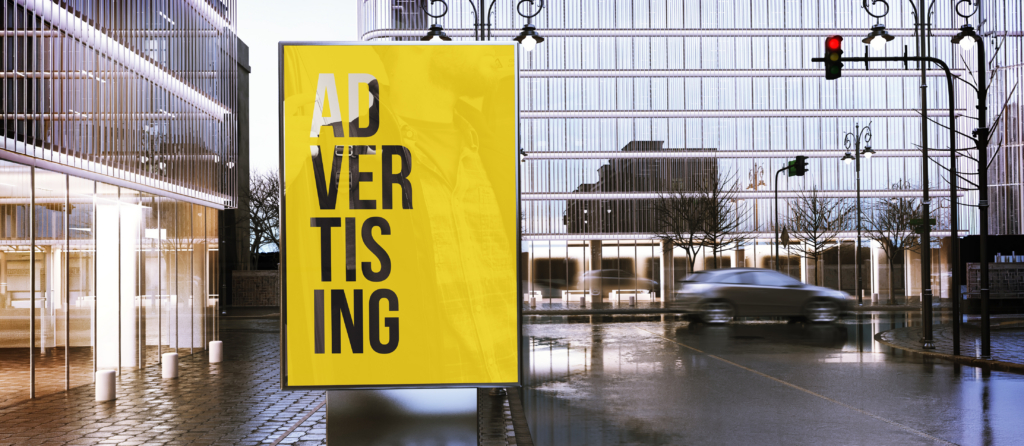

Unlike ads that show up in social media feeds and web browsers, OOH advertising operates in shared physical spaces. They are often displayed in formats no smaller than a poster but can be as tall as several floors of a city building. OOH cannot be skipped, closed, or ad-blocked, and in many high-traffic areas it is almost impossible to avoid. In concentrated OOH areas like major metropolitan city centers and tourist destinations, OOH ads are so dominant that they compete for attention and make it hard to know where to look.
The 5 major OOH formats
- Billboards & wallscapes: High-impact city and highway ads, digital boards, and massive urban wall murals designed for long-range visibility and brand authority.
- Transit media: Advertisements wrapped around or inside buses, subways, commuter trains, and taxis, or around transit hubs like airports and train stations, capturing audiences during periods of extended dwell time. In vehicles, the ads are served up to commuters, while exterior spots promote products and services to pedestrians and drivers.
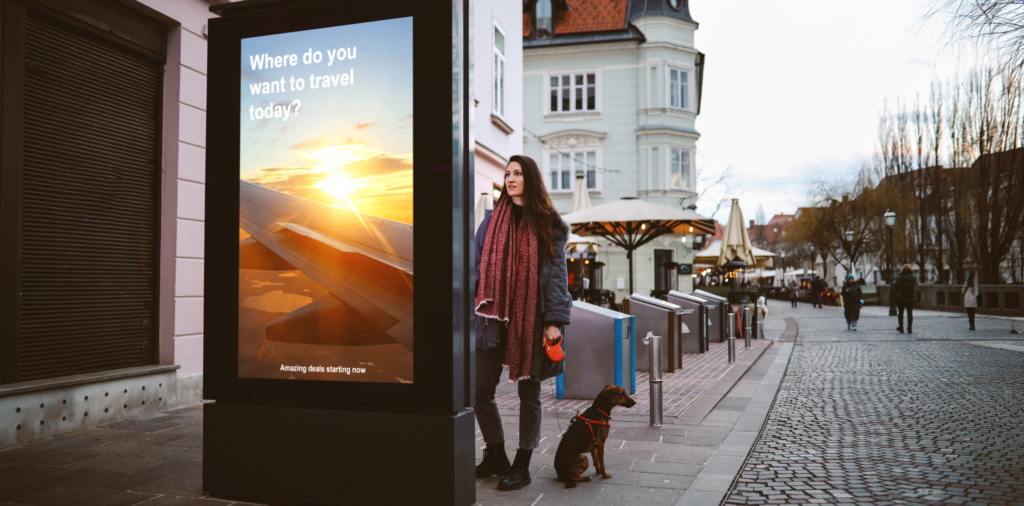
- Street furniture: Eye-level displays integrated into pedestrian pathways, including bus shelters, newsstands, urban kiosks, and bike-share stations.
- Place-based media: Specialized digital screens situated where specific crowds gather or advertisers can expect temporary attentive audiences, such as gyms, office elevators, shopping malls, EV charging stations, and gas stations.
- Architectural signage: Ultra-large custom outdoor displays, branding, and in-venue ads in high-traffic spaces or on field-adjacent displays in stadiums.
Who is OOH for?
Historically, OOH was reserved for big companies with massive advertising budgets because of long-term ad-buy commitments and the costly process of printing large billboards and banners. Today, thanks to programmatic buying and digital screens, brands of all sizes can leverage OOH and purchase ad space in time slots that fit almost any budget:
- Online goods/services & tech brands: Digital-native companies use physical OOH placements to build real-world credibility, complement online marketing campaigns, and reinforce brand recognition by taking their online image into the physical world.
- Local businesses & service providers: Brick-and-mortar stores, law firms, and medical practices utilize hyper-local street furniture and regional billboards to capture views from nearby foot and vehicle traffic.
- B2B companies: B2B firms strategically place transit and place-based ads near major convention centers, financial districts, or corporate hubs, especially during key industry events, conventions, and trade shows.
- Enterprise consumer brands: Global CPG, auto, and entertainment brands rely on OOH for rapid market saturation, launch campaigns, and high-visibility storytelling.
The current OOH landscape
OOH ads typically offer a mix of print and electronic placements, but digital ads delivered through highly customizable platforms are dominating the space. The allure of variable terms (buying digital ad spots for minutes or hours vs. a month at a time in print formats), demographic targeting, and flexible creative options that can be rotated through time slots makes digital OOH (sometimes referred to as DOOH) the preferred platform.
Programmatic Digital Out-of-Home, or pDOOH, has further expanded the possibilities of buying and selling OOH ads, serving ads to hyper-specific audiences at preferred times or in key markets.

What the future of OOH looks like
The transition from static vinyl billboards to DOOH kicked off a new era of OOH advertising. Now, the integration of AI and advanced location data is pushing OOH into a fully dynamic, reactive medium. Current capabilities make it possible to analyze audience demographics in selected areas and serve targeted ads to those audiences in real time.
Advances in AI, machine learning, and mobile user data tracking will usher in a more advanced and personalized OOH ad delivery system and further narrow the scope to more precisely analyze demographic data and respond instantly.
Here are some future growth areas to watch in the OOH space:
Dynamic Creative Optimization (DCO)
Future OOH ads will improve dynamically adapted content and elevate the quality of live, proximity-specific data. This is already happening to some extent, but AI systems will become more efficient at ingesting real-time data (weather conditions, traffic delays, transit disruptions, sports scores) and automatically altering ad messaging. This will include deeper data points like real-time store inventory, so advertising moves from basic reactionary content displays (if it’s raining, show ads for rain gear), and instead generate ads based on more actionable data (if it’s raining, generate ads for our best-selling rain boots that are current in-stock at our store location 2 blocks away and include a 10% off discount code).
AI will also factor into the content creation process, using generative AI platforms to render non-templated visuals, localized copy, and video layouts on the fly.
DCO engines will also better customize visuals on anamorphic screens, dynamically adapting 3D lighting, shadows, and perspective geometry to match real-time sun angles, ambient lighting, and viewing positions.
Generative AI & instant hyper-localization
Generative AI allows creative teams to instantly produce localized variations of a single campaign. Near-future AI systems will take this a step further, automatically altering ad layouts to include localized landmarks, neighborhood references, or language nuances across thousands of digital screens in seconds.
Predictive foot traffic & programmatic buying
Rather than buying a billboard on a month-long contract, programmatic DOOH (pDOOH) lets advertisers bid on screen placements minute by minute based on real-time audience movement.
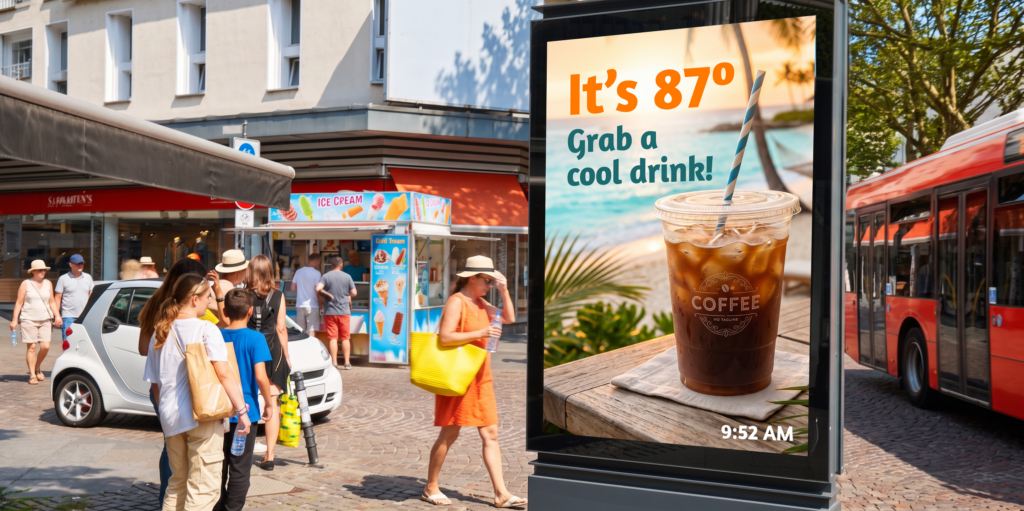
Predictive models will take this even further. Machine learning models can already analyze privacy-compliant mobile location data to purchase ad slots specifically when target demographic densities peak. For example, a running shoe brand can focus its advertising efforts in areas runners frequently use during early morning runs between 6:00 a.m.- 8:00 am.
Or a coffee shop brand can specify that their iced coffee ads should be activated to replace their hot coffee ads on sidewalk screens within a 5-block radius of any store location between the hours of 8:00 am and 11:00 am when local temperatures pass 85°F and pedestrian traffic is at least 30% within their ideal iced coffee target age demographic of 18-39.
Newer models will give advertisers even more control and insight into when their ads should run and what their ad spend will look like based on advanced predictive models.

Attention analytics
Mobile data is already being used to analyze advertising demographic groups and respond in pDOOH ad delivery systems. But some cutting-edge DOOH networks are now deploying advanced, privacy-friendly AI sensors to capture more viewer data. Without storing facial images, these sensors can scan the faces of people near a digital billboard and report metrics such as gaze direction, dwell time, and crowd density, giving advertisers more precise data on attentive impressions.
Advances in OOH technology will fine-tune these analytics and calculate more accurate impression data. Current systems estimate view counts based on approximate head-tilt angles to determine whether a viewer is likely looking in the direction of the ad screen. More precise edge AI sensors can determine whether a viewer is actually paying attention to the ad or simply glancing in the general direction of the screen.
Tech-driven earned reach
Advertisers have capitalized on the secondary effect of social sharing for OOH ads. Beyond the views and engagement advertisers look for from the campaign itself, social amplification can create a second wave of impact and take a physical, location-specific ad to a broader, non-local audience. Sometimes referred to as “earned reach,” these bonus impressions are generated when people photograph, share, and discuss an ad on social media.
Often, the viral social effect is a happy accident, but more recently advertisers have found success in social OOH (sOOH) by leveraging technology to create spatial experiences viewers want to photograph and share. Anamorphic billboards turn two-dimensional spaces into 3D visual experiences and often surprise viewers who see these ads for the first time.
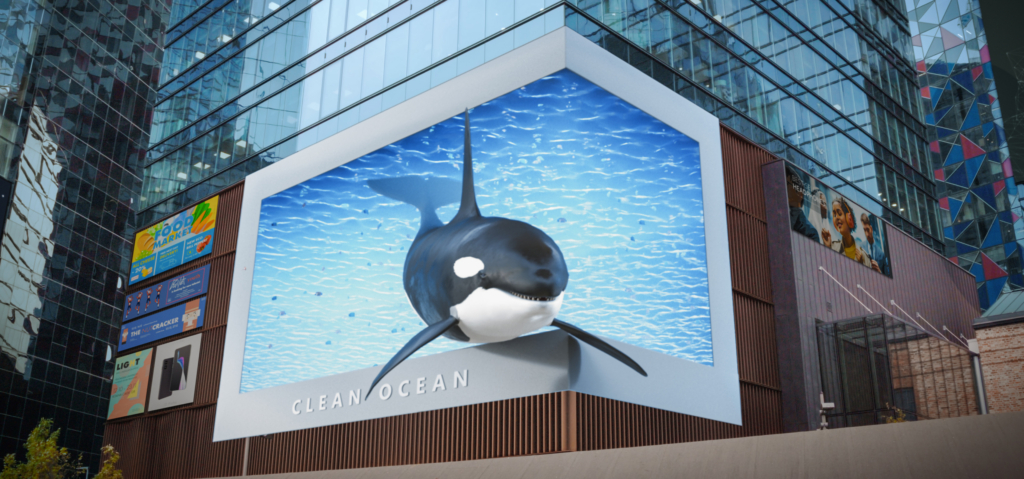
The future of earned reach in the OOH space will likely lean heavily on these types of tech-driven experiences that push the boundaries of advertising. Combined with AI and programmatic DOOH (pDOOH), sOOH will look to take advantage of real-time data and adjust these spatial experiences to modify ad content for current environmental conditions, social trends, and crowd demographics.
Print is not dead
The flexibility and ease of digital ad deployment still rule the OOH world, but print still holds an important place among the tech-driven formats. In some spaces, digital displays just aren’t practical or even possible, and print can fill the gaps in digital screen availability. Print can also be more versatile as a physical medium, with opportunities to pop up a lightweight banner stand in places where screens don’t exist, or wrap a vinyl banner around a structural column or other architectural feature.
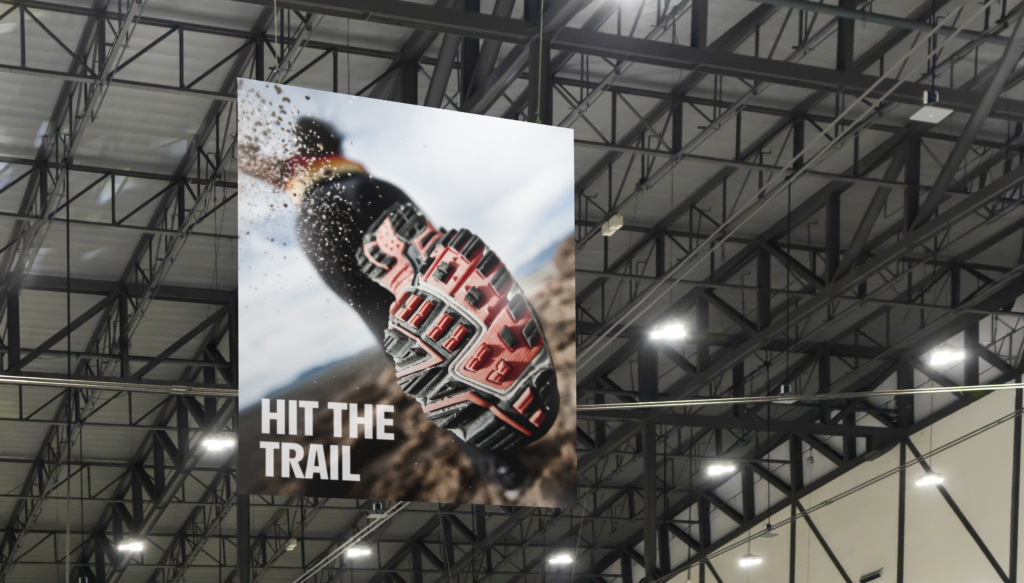
Print goes where the square and rectangular digital screens can’t, including vehicle wraps, hanging banners, and curved surfaces.

The creative component
Delivering acutely targeted OOH ads to audiences that fit key demographics within a preferred age range or foot traffic profile is just one piece of the puzzle, though. Another key component is what the viewer sees and whether the ad creative resonates with them or is entirely forgettable.
It is not enough to simply serve up an ad for the right product at the right time. In spaces where brands are constantly competing to get eyes on billboards, marketers are challenged to deliver thoughtful, witty, well-designed ads that win that battle for attention.
One goal of large-scale OOH advertising should be to start a broader viral conversation. As Levi’s unintentionally demonstrated during the 2026 World Cup, being a part of the conversation is sometimes more valuable than being visible. In a year when Levi’s spent millions on a Super Bowl ad, their biggest advertising win might have instead come from a viral moment where they weren’t supposed to be seen at all.
Subversive, minimalistic, or tongue-in-cheek messaging can get people talking. Adding some humor, pairing impactful design with thoughtful messaging and headlines, and telling memorable brand stories through the life of a campaign can help your OOH marketing stand out in the crowd.
The Takeaway
The potential ROI on Out-of-Home advertising has grown in parallel with the expanded tools, technologies, and capabilities that advertisers can use to maximize their OOH ad spend. It has become an intelligent, dynamic, and valuable bridge between the physical environment and digital customer journeys. As physical spaces become smarter, OOH will continue to lead as one of the most impactful ways for brands to make a lasting impression, especially among targeted audiences and high-value customer demographics.
Is OOH for everyone? It can be. With the ability to deliver ads to very specific target groups in key locations and with the flexibility to bid on short-term placements, just about any business can find ways to reach new customers with OOH.
This is no longer a game of rolling the dice on a month-long ad buy and crossing your fingers in hopes that someone genuinely interested in your product or service will see it. The same benefits afforded to social and PPC ad campaigns in terms of your ability to fine-tune when and where your ads are seen is now fully available to OOH spaces. Future advances in programmatic DOOH will make customized ad targeting even more powerful and accessible.

Just be sure to roll out high-quality, thoughtful, impactful, and creative ads in any OOH campaign. It’s not enough to simply grab your target audience’s attention. Your ad creative needs to be memorable in a constantly changing space, and that requires strategic planning, bold creative development, and unique messaging to win those Out-of-Home views.