


How to Leverage AI Without Losing Your Brand Voice
Your B2B messaging strategy is the foundation of your brand: your website, your sales pitch, your campaigns. Get it right, and prospects immediately understand why they should choose you. Get it wrong, and even a great product gets overlooked, or worse, misunderstood.
AI has fundamentally changed how fast we can develop messaging, but speed comes with a catch. If you’re not careful, LLMs will make your brand sound like everyone else. The key differentiator is a workflow that feeds AI the right inputs: real customer research, sharp positioning, and a clear framework. From there, you apply human judgment to refine.
Here’s the 8-step process I use to accelerate B2B messaging projects while keeping the work grounded in research and unmistakably on-brand.
1. Measure AI Brand Perception
If you’re embarking on a messaging exercise for an existing company, there’s a good chance their current content isn’t quite resonating with prospects. Or maybe the company has launched fresh offerings, or new competitors have entered the field. Whatever the reason…

We built a Search and AI Visibility Audit tool that provides a comprehensive picture of a company’s rankings for target keywords and buyer questions, which platforms are citing them, what they’re saying, and offers a clear roadmap for improvement.
We preload the tool with 25-50 commonly asked questions about our client’s industry and the types of services they provide, then ask which company the LLM recommends and why. Here’s a small sampling of these questions:
- Who are the leading providers of [company’s offerings] among [the company and competitors]?
- Which of [the company and competitors] is considered the industry standard and why?
- Rank [the company and competitors] by market leadership and credibility.
- Compare [the company and competitors] by core product focus and primary use cases.
- For [this problem I’m looking to solve], how should I choose between [the company and competitors]?
- What are the key differentiators between [the company and competitors]?
We measure and document how ChatGPT, Gemini, and Perplexity answer these questions, as well as AI overview mentions and Google SERP placements.
This approach:
- Gives us AI’s objective interpretation, which typically aligns with the perceptions of real human searchers.
- Tells us verbatim what LLMs are saying about our client, who they’re recommending, and provides insights into why.
- Shows us where our client’s gaps are relative to their competitors.
- Gives us an accurate performance baseline, which we can improve and remeasure over time.
Don’t have a fancy visibility audit tool? You can do some of this manually by entering the questions into LLMs yourself, or we’d be happy to run a thorough Search & AI Visibility Audit for you.
2. Use a Messaging Framework That Puts the Customer First
We’re believers in the StoryBrand messaging framework, which challenges us to think of the customer as the hero of the story. Just as Yoda did for Luke Skywalker, the company (our client) is the guide that calls the hero (their customer) to action, provides a plan to help them avoid failure, and leads them to their desired outcome.
Focus your messaging on the customer’s needs, not on how long the company has been in business or on grandiose statements like “we’re simply the best.”
Start by stating, in simple terms, the benefits the prospect will get from using the company’s products or services, and give use cases to demonstrate how the company has solved similar problems. Further down the page, include validators such as industry memberships and awards, years in business, and customer logos.
It’s important to have a messaging framework like this in mind to help you guide your messaging workshop, which brings us to point #3…
3. Run a Messaging Workshop With Stakeholders

Because chat platforms can help accelerate the drafting of new marketing messaging, it’s tempting to let your favorite LLM have at it and see what happens. However, LLMs are only as good as the research material you provide them with or that they can find on the web. If you don’t set up a solid foundation, the LLM will be guessing or, worse, make things up.
There is still no substitute for hearing from real people who intimately understand the market and the company you’re writing content for, even in the age of AI.
Conduct a messaging workshop to hear directly from:
- Senior company leadership: to understand how they want the company to be perceived and where they feel their current messaging falls short.
- Top-performing sales team members: to gain insights into what their customers want and what wins (and loses) deals.
These are the types of questions you should be asking in a messaging workshop:
- What problems do we solve as a company?
- How do we empower our customers?
- What are our core characteristics?
- What reasons do prospects have to believe?
- What are our differentiators? How are we unique?
Internal input is foundational, but it’s equally important to interview your client’s customers if you can. Some guidelines for customer interviews:
- Keep calls as short as possible (30-45 minutes) to respect their time.
- Remember that you represent your client:
- Arrive with an intimate understanding of the company, the market, and the challenges their customers typically face. Conducting these calls after the internal messaging workshop will ensure you’re well-prepared.
- Be friendly, genuinely curious, and ask follow-up questions.
- Schedule one customer at a time to receive candid answers.
- Use a script featuring the types of workshop questions noted above.
- Include an open-ended question or two to allow each customer to discuss anything you hadn’t anticipated.
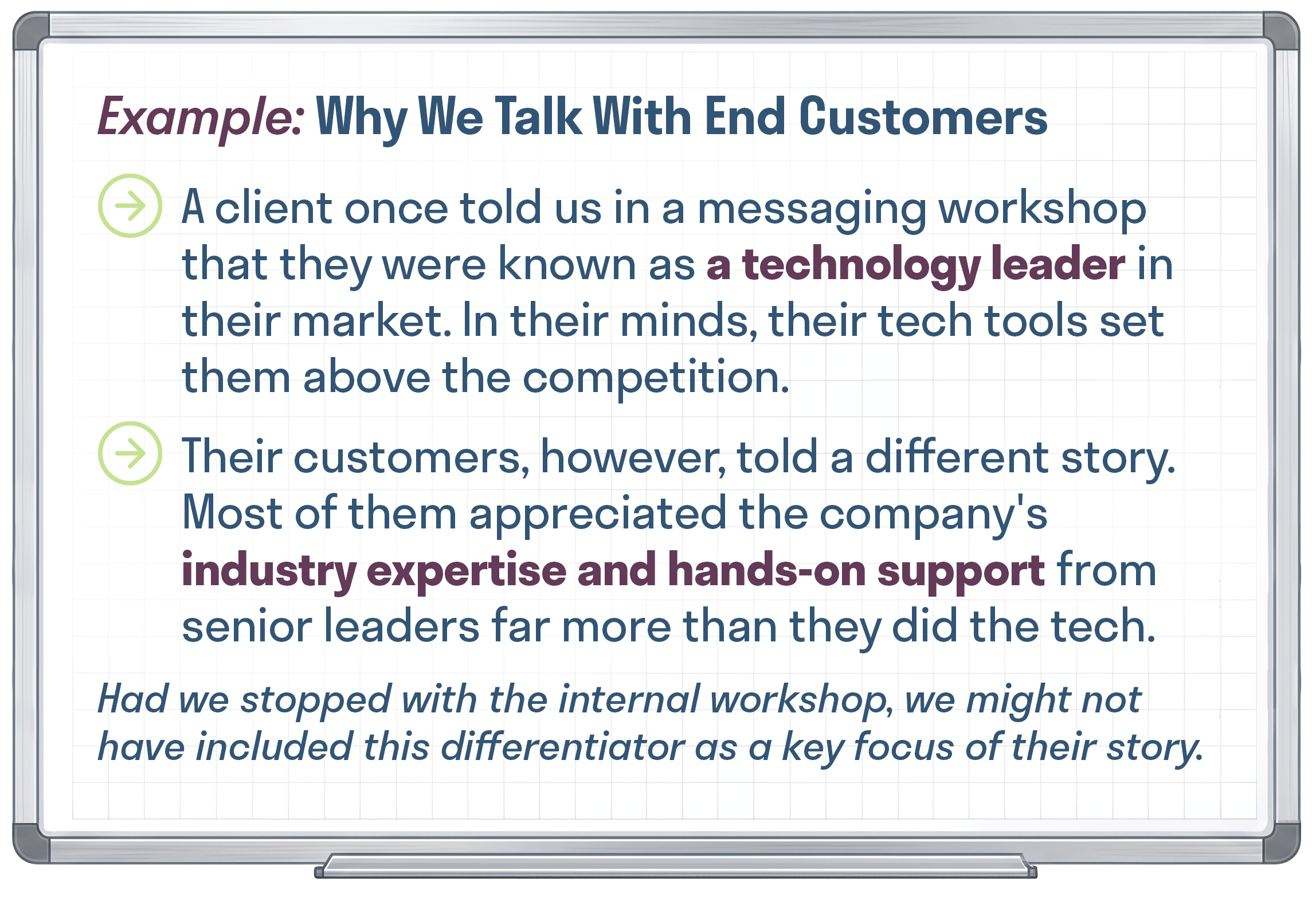
Compare what the company’s leaders said with their customers’ input. You may find that the two groups have differing perceptions of the company’s value.
4. Synthesize and Document Your Research
When it comes time to start drafting content, it’s cumbersome to flip through pages of notes or re-listen to call recordings. You’ll need electronic documents you can keyword-search and easily skim to jog your memory.
- Record every call or meeting (with permission, of course).
- Use AI to transcribe the recordings.
We used to pay a few bucks to send recordings out to Rev.com, which uses AI with the option for human review. Today, any LLM platform can do this in a matter of seconds. Platforms like Otter.ai are purpose-built AI notetakers with integrations for Zoom and Google Meet.
Believe it or not, we have the best results using Slack, the messaging and collaboration platform. Slack automatically transcribes every word of uploaded recordings, with time codes, and remains fairly accurate.
Whatever transcription method you choose, there is no getting around the need for a real human to review the transcriptions and summarize the findings into skimmable bullets organized by messaging framework topic.
- Invite all content creators to refine the findings and review them on a call with the client to make sure you’re on the same page.
5. Wireframe Before You Write
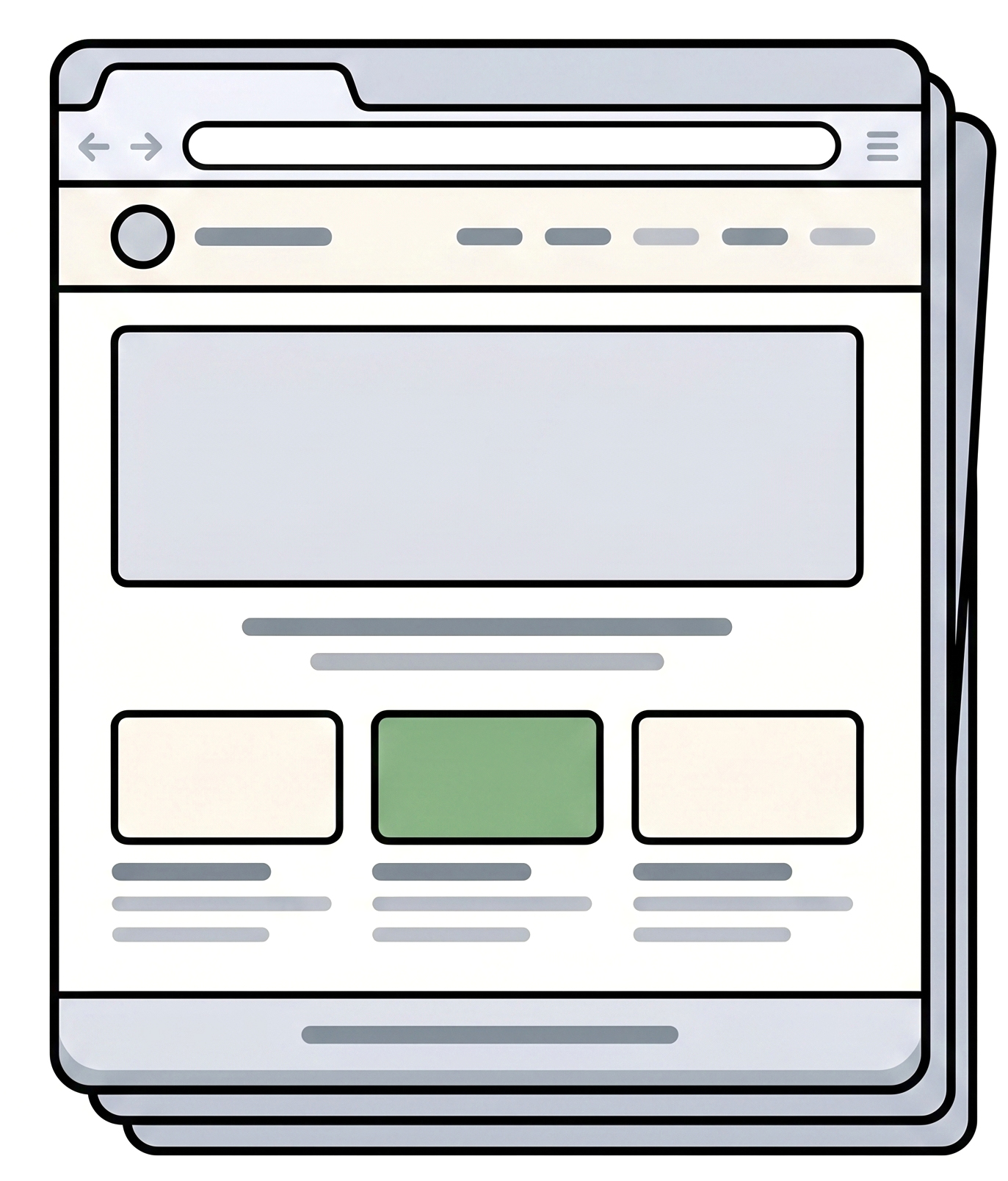
It’s much easier to tell a compelling story within a preplanned format than it is to write free-form, whether you’re writing a brochure or an entire website. Using your messaging framework and what you’ve learned from the interviews you’ve conducted, create a “strawman” wireframe that clearly indicates what type of content needs to go in each section of each page.

A typical B2B webpage wireframe might look something like this:
- Hero Area:
- Write a short, punchy headline that summarizes how the product or service helps customers.
- Include a subheading to expand upon the main headline, if needed.
- Add a more detailed benefits-led summary paragraph.
- Benefits Section:
- Call out the top two to four benefits to the customer, each with a headline and supporting sentence.
- Who We Serve Section:
- If applicable, list the types of customers the company helps.
- Products Section:
- Feature all products or services that would help this customer base, with links to the full product detail pages.
- Validators Section – Reasons to Believe:
- Customer logo scroll
- Awards, associations, years in business, undisputed leadership positions, etc.
- Use Cases
- Real-world stories that demonstrate what the company’s solution has done or could do for similar customers, including the:
- Challenge
- Solution
- Benefits
- Real-world stories that demonstrate what the company’s solution has done or could do for similar customers, including the:
- Client Testimonials
- Named customers are good, and video testimonials are even better, but make them anonymous if you need to.
- Call to Action and Plan
- What do you want the prospect to do next? Fill out a form? Schedule a demo? Sign up? Whatever it is, make it simple and clear, and spell out what will happen next when the prospect completes that action.
6. Put AI to Work on the First Draft

Now that you’ve done your research and created your outlines, you can either start writing content yourself or leverage AI to assist. Before we ask an LLM to generate anything on its own, we prime the pump with the following:
- Any existing documents in the company’s brand voice, such as data sheets, brochures, existing web pages, and brand guidelines.
- The transcribed and organized notes from the messaging workshop.
- Links to the company’s competitors.
- The results of the search and AI brand perception audit.
- Our wireframes.
Take It One Section at a Time
Again, it’s tempting to speed things along and ask your AI platform of choice to write entire pages at a time, but we’ve found that leads to mistakes and repetition. Think of AI like a superfast intern that’s good at synthesizing large quantities of information quickly, but needs to be carefully managed along the way.
I take it section by section, starting with the benefits, then moving to use cases, and then to validators.
I rarely take an LLM’s first draft as gospel, and regularly ask questions, challenge its assumptions, and do my own rewrites. I usually feed my rewrites back into the LLM and explain why I made the change. This process helps the platform learn the company’s voice, priorities, and what we can and can’t claim, so the drafts improve over time.
Once the LLM and I have dialed in the benefits and use cases, I ask it to suggest some headlines and copy variations for the hero area at the top of the page. The hero copy needs to boil down the deeper information into bite-sized chunks that reel in the reader, and it’s hard for an LLM to get there until it’s done more of the detail work on the rest of the page.
7. Read, Rewrite, and Humanize
When you have a draft in hand, preferably in a cloud-based app like Google Docs for easy collaboration, it’s time to get a fresh set of eyes.
They might point out some AI “tells” that you missed, such as repetition of words, too many lists of three, or the overuse of em dashes. I do my rewrites with their feedback in mind, taking care to vary the content to humanize it and make it more enjoyable to read.
8. Run a Final Scrutiny Check

In addition to our own reviews, we like to get a second opinion before sharing any new messaging with our clients. My colleague has extensively trained Claude on our clients by uploading hundreds of documents and integrating them into our Search and AI Visibility Audit tool.
As a final step, we have Claude run a “Scrutiny Report” on any pages we’ve developed using other LLMs, such as ChatGPT. We’ve trained Claude to look for the following:
- Verified claims versus unsourced superlatives
- AI signals, such as:
- Lists of three
- Lack of citations
- Repetitive language
- Accuracy to the brand voice
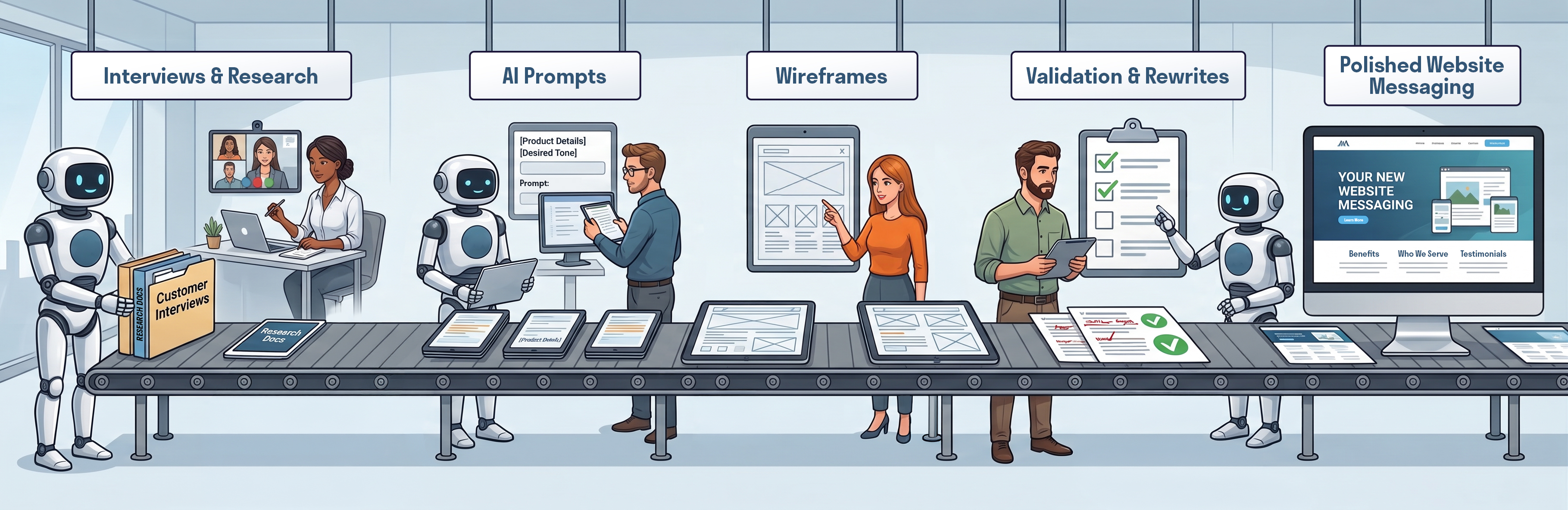
It may be hard to believe, given the many steps I’ve outlined here, but this workflow has significantly accelerated our messaging work. Some heavy lifting is required up front, with thorough reviews and rewrites throughout, but once we’ve properly laid the groundwork, we can produce effective website copy rapidly.
If you need help conducting a messaging exercise, rewriting copy, or integrating AI into your workflow, please reach out to us.