


It should come as no surprise that the way people search is rapidly changing from day to day. The advent of Generative AI and machine learning has offered a new, streamlined way for consumers to find what they are looking for in a succinct and simple way. At the same time, traditional search continues to dominate the market share (for now).
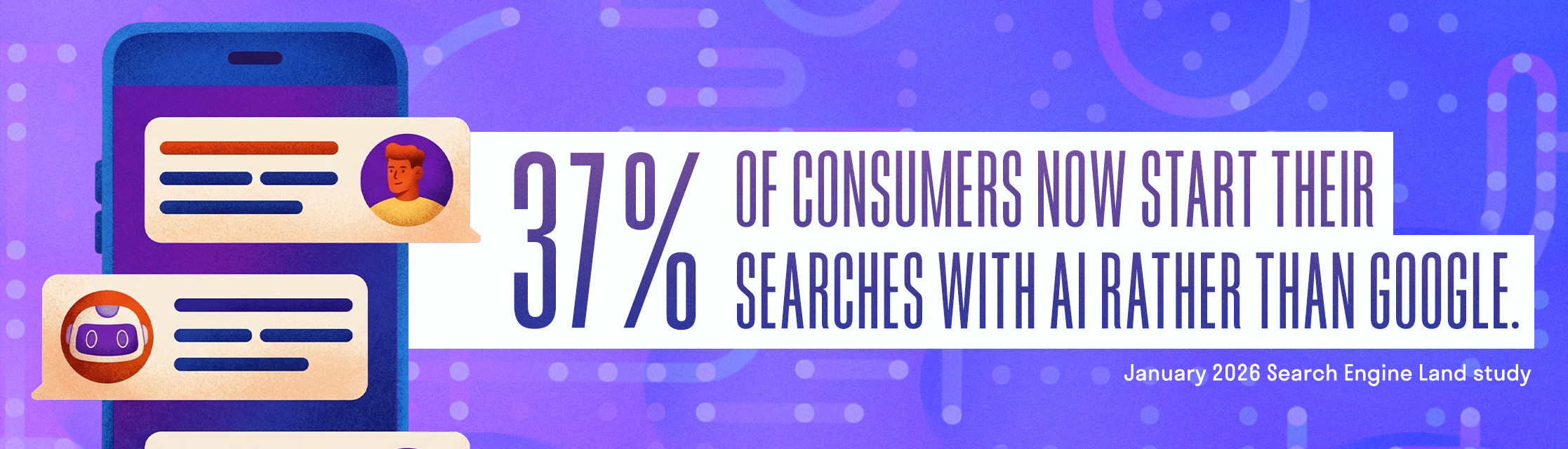
As it stands, 37% of consumers now start their searches with AI rather than Google, signaling a massive shift from just two years ago. Yet traditional search engines still command 90% of global search traffic. How can both be true?
In 2026, people use search in two distinct ways: AI tools for exploratory research and quick answers, and traditional search engines for decision-making and purchases. This split-path model is reshaping how businesses need to approach visibility.
Based on recent studies from Deloitte, Gartner, AP-NORC, and Pew Research, here’s what the data reveals about how people actually search in 2026.
Traditional Search Engines Still Dominate Volume
Despite headlines about AI disruption, Google and traditional search engines remain the primary way people find information online.
Google holds 90% of the global search market share and 85% of the U.S. market. The search giant processes tens of billions of searches per day. Industry analysis shows that Google had approximately 26 times as many daily visits as ChatGPT did at its peak.
The market share numbers tell an important story. Google’s global dominance has declined from 93% in 2022 to 90% in 2026, while AI platforms’ share has quadrupled from 0.03% to 0.13%. The trend is clear, but the scale remains overwhelmingly in favor of traditional search.
As one analyst noted, “Most queries still land on classic search engines, even as AI use grows from a low base.” AI isn’t a sudden replacement, but there is a gradual shift in how consumers distribute their information-seeking behavior across different tools.
For businesses, this means traditional SEO isn’t going away. The vast majority of search traffic, particularly for commercial queries, still flows through Google and traditional search engines. Organizations that abandon SEO strategy in favor of AI optimization alone risk losing access to 90% of search volume.
The Rapid Rise of AI-Powered Search
While traditional search remains dominant in volume, AI-powered search tools are experiencing explosive growth.
According to a January 2026 Search Engine Land study, 37% of consumers now start their searches with AI rather than Google, a dramatic increase that reflects shifting search habits, particularly among younger demographics. A July 2025 AP-NORC survey found that 60% of U.S. adults have used AI to search for information, with adoption rates reaching 74% among people under 30.
The growth trajectory is steep. ChatGPT has doubled from 400 million to 800 million weekly active users between February 2025 and January 2026, processing over 2 billion daily queries. The platform now commands 81% of the generative AI market, making it the default AI search tool for most consumers.
Deloitte’s TMT Predictions 2026 forecasts that 29% of adults will initiate daily searches with generative AI summaries in 2026, compared to just 10% using standalone AI apps. The research suggests that AI in search will be 300% more common than standalone AI tools, reflecting Google’s integration of AI Overviews and other platforms that embed AI into existing search experiences.
The demographic split is significant. Yahoo and YouGov data show that 82% of Gen Z adults have used AI chatbots compared to 68% of millennials. Among AI users under 30, 28% use AI several times per day for search. When asked about their primary use case, 58% of AI users cite “fact-finding and quick answers” as the top purpose.
Gartner predicts traditional search engine volume will drop 25% by the end of 2026 as search marketing loses market share to AI chatbots and virtual agents. These data indicate a rapid rise in the use of AI assistants alongside traditional search, especially for quick, conversational queries.
Different Tools for Different Search Intents
AI search and traditional search serve distinct purposes, and understanding this difference is key to understanding the split-path model.
AI search characteristics:
- Natural language questions (“What factors should I consider when choosing CRM software?”)
- Synthesized answers without requiring link clicks
- Fast, conversational interaction
- Exploratory and brainstorming use cases
- Best for broad questions like “What should I consider?”
Traditional search characteristics:
- Keyword-based queries (“HubSpot pricing,” “best CRM reviews”)
- Link-clicking and comparison across multiple sources
- Validation through multiple viewpoints
- Detailed product specs, pricing, and reviews
- Best for specific questions like “Who should I buy from and at what price?”
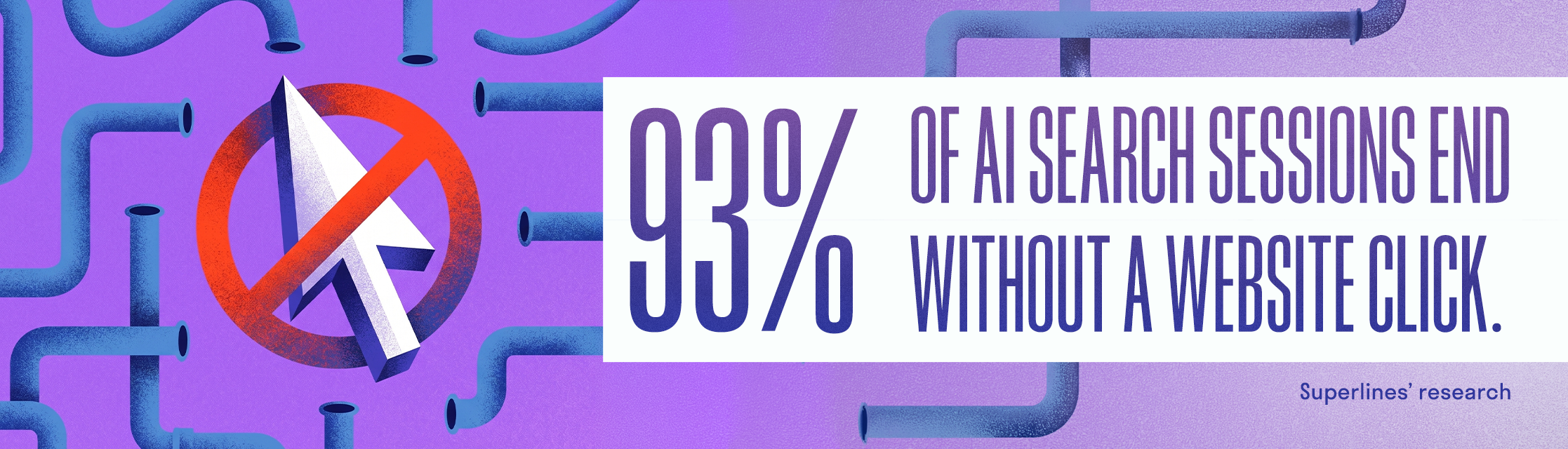
The data supports this behavioral split. Superlines’ research found that 93% of AI search sessions end without a website click. Users get their answers from the AI summary and move on. Meanwhile, Semrush data show that 58.5% of U.S. Google searches now end with zero clicks, while AI Overviews appear in 13.1% of desktop searches, up 72% year-over-year.
The Pew Research Center found that 65% of adults see AI summaries in their search results at least sometimes. One tech worker quoted in the study explained their usage pattern: “It has to be a basic question” before they rely on the AI summary. For anything that requires depth or validation, they scroll past the AI overview and click through to the actual sources.
This suggests a hybrid workflow emerging in consumer behavior: use AI for quick fact-finding or brainstorming, then fall back on traditional search and link-clicking for validation and detail. The lines are blurring as Google adds AI features, but user intent still varies depending on where they are in the decision-making journey.

The Split-Path Model for Commercial Decisions
The most important pattern for businesses to understand is how consumers use both AI and traditional search in sequence when making purchasing decisions.
Phase 1: Exploration (AI Tools)
Consumers begin with broad natural-language questions. A bank IT director might ask, “What features do banks look for in CRM software?” or “What are the pros and cons of HubSpot versus Salesforce?” The AI provides concise summaries and helps narrow categories, working as a “pre-filter” to quickly generate a shortlist of solutions worth investigating.
This exploration phase is where 37% of searches now begin. Users appreciate the speed and synthesis AI provides. According to the Search Engine Land study, 60% say AI delivers better, clearer answers than traditional search results. The AI serves as a research assistant, helping consumers identify which questions they should ask and which vendors warrant deeper investigation.
Phase 2: Decision (Traditional Search)
Once consumers have a shortlist, queries become concrete and transactional. They search for “Company X pricing,” “HubSpot case studies for banks,” or “Salesforce user reviews.” They click through multiple links, download comparison guides, read reviews, and visit brand websites. Final vendor selection and purchases happen in this phase.
As one industry analyst put it: “AI serves ‘what should I consider?’, while search engines answer ‘who should I buy from and at what price?'”
This model persists because AI excels at speed and synthesis, while traditional search provides validation and detail. The trust gap between AI and traditional sources (which we’ll explore next) keeps users from making significant decisions until they check multiple sources. Commercial decisions require pricing transparency, user reviews, and detailed specifications – information that requires visiting actual vendor websites, not just reading AI summaries.
For businesses, this means AI shapes the shortlist, while search drives conversion. If you’re not appearing in AI results when consumers ask exploratory questions about your category, you may never make it to the consideration set. But if you’re only optimizing for AI and neglecting traditional SEO, you’ll lose prospects at the decision stage when they’re ready to buy.
Trust and Demographic Patterns
Despite rapid adoption, consumers remain skeptical of AI search results.
All About AI research found only 19% of people trust AI search results, compared to 45% for traditional search engines, a trust gap of more than 2:1. The AP-NORC State of the Facts 2024 study found only 8% think AI chatbot answers are always or often factual, while just 12% trust AI-assisted search results at the same level they trust traditional sources.
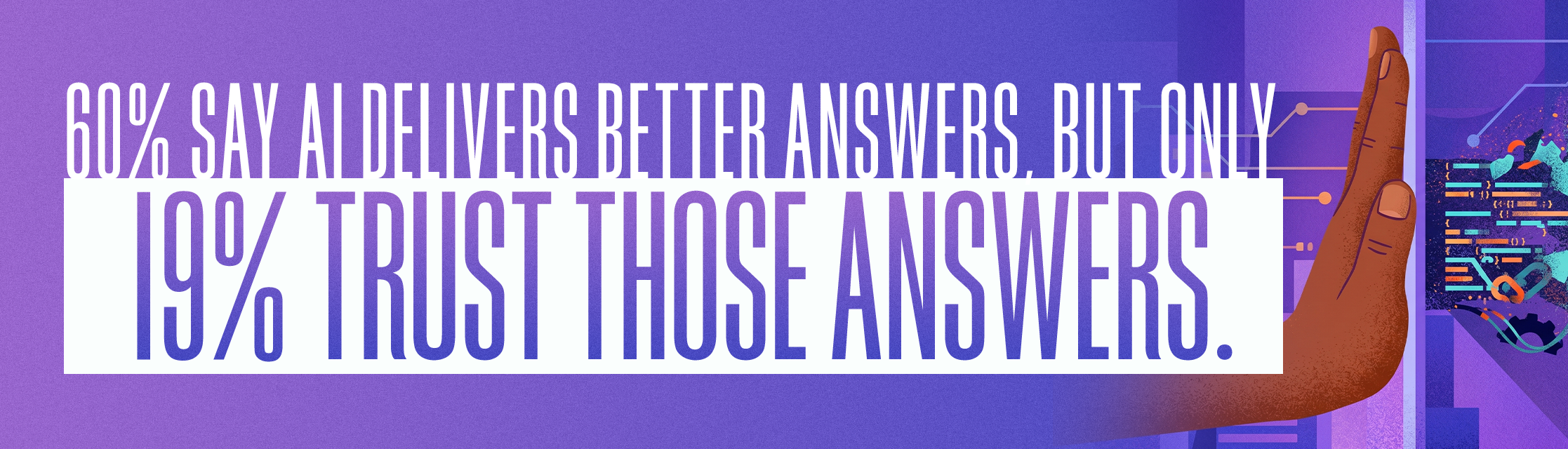
This creates a paradox: 60% say AI delivers better answers, but only 19% trust those answers.
Why does the trust gap exist? Consumers cite concerns about AI hallucinations and errors, lack of source transparency, and unreliability for factual queries. When asked whether AI makes it easier to find accurate information, only 16% said it does, while 40% said it makes it more challenging. Pew Research data shows 75% of adults never get news from AI chatbots, reflecting particular caution around consequential information.
The demographic split is notable. Younger people embrace AI despite trust concerns. They’re digital natives who see AI assistants as a normal information channel and prioritize convenience over verified accuracy for low-stakes queries. Adults under 50 are about twice as likely as those over 50 to get news from AI chatbots, though absolute numbers remain low across all age groups.
The takeaway: usage is growing despite trust issues because convenience wins for low-stakes queries. Consumers will ask AI about restaurant recommendations or gift ideas, but still turn to traditional search for medical information, financial decisions, or major purchases.
What This Means for Businesses
The split-path model creates new requirements for businesses seeking visibility in consumer research and purchase journeys.
Strategic Implications:
- Optimize for both channels: AI is the “front door” where consumers form consideration sets, but search drives conversions. Businesses need content strategies that address both exploratory questions (for AI) and specific product queries (for traditional search).
- Different content for different stages – Create educational content that answers broad questions AI users ask during research, and detailed product content with pricing, specifications, and reviews for consumers in the decision phase.
- AI shapes consideration sets – If your brand doesn’t appear in AI results when consumers ask category questions, you may never make the shortlist for further evaluation. This is particularly important for B2B and high-consideration purchases where consumers begin with exploratory research.
- Legacy search remains critical – Traditional SEO remains essential because 90% of search volume and most commercial-intent searches still occur on Google and similar platforms. Commercial intent, pricing queries, and final purchase decisions overwhelmingly happen through traditional search.
For businesses, this means optimizing content for both traditional SEO and emerging AI-based channels. Ensure your content is AI-citable by maintaining authoritative, well-sourced information that AI tools can synthesize and reference. At the same time, maintain traditional SEO best practices for the vast majority of searches that still begin and end on search engines.
For a detailed guide on optimization strategies across traditional SEO, AEO (Answer Engine Optimization), and GEO (Generative Engine Optimization), see our companion article: SEO vs AEO vs GEO: Understanding Modern Search Optimization.
FAQ
Is AI replacing Google for search?
No. While 37% of consumers now start searches with AI, Google still commands 90% of global search traffic. AI is growing rapidly, but serves a different purpose: exploratory research rather than final decision-making. Gartner predicts traditional search volume will drop 25% by late 2026, but that still leaves the vast majority of searches happening on traditional engines.
What percentage of people use AI to search?
60% of U.S. adults have used AI to search for information at some point, with adoption much higher among younger demographics (74% of under-30s). However, only 29% initiate daily searches with AI summaries. ChatGPT processes over 2 billion daily queries globally, compared to tens of billions on Google.
Do younger people use AI search more than older adults?
Yes, significantly. 82% of Gen Z adults have used AI chatbots compared to 68% of millennials. Among those under 30 who use AI, 28% use it several times per day for search, compared to roughly 10% of older users. Adults under 50 are about twice as likely as those 50+ to get news from AI chatbots.
Why don’t people trust AI search results?
Only 19% of people trust AI search results, compared to 45% for traditional search engines. Trust concerns stem from AI-generated hallucinations, a lack of source transparency, and factual errors. Only 8% think AI chatbot answers are always or often factual. Despite this, 60% say AI delivers better, clearer answers, creating a paradox in which convenience drives usage despite trust concerns.
Should businesses optimize for AI search?
Yes, businesses should optimize for both AI and traditional search. AI tools are increasingly the “front door” to consumers’ decision journeys (37% now start searches with AI), so appearing in AI results helps shape consideration sets. However, traditional search remains critical for conversion, as it still handles 90% of queries and drives final purchasing decisions.
How is AI search different from Google search?
AI search uses natural language questions and provides synthesized answers without requiring users to click links (93% of AI sessions end without clicks). Traditional search uses keyword-based queries and returns a list of links to explore. AI excels at exploratory questions and quick facts, while traditional search is better for detailed research, price comparisons, and validating information from multiple sources.
What is the split-path search model?
The split-path model describes how consumers now use both AI and traditional search in sequence. In the exploration phase, they use AI chatbots to ask broad questions, get summaries, and narrow options (“What should I consider?”). In the decision phase, they switch to traditional search engines to research specific vendors, compare prices, read reviews, and make purchases (“Who should I buy from?”).