


If you’ve been keeping up with digital marketing trends, you’ve probably seen new buzzwords popping up: Answer Engine Optimization (AEO) and Generative Engine Optimization (GEO). These new terms are discussed alongside traditional Search Engine Optimization (SEO) as if they were entirely separate disciplines. Spoiler: they’re not.
AEO and GEO describe how content is discovered and delivered in an evolving search landscape, where more people than ever are turning to generative AI for answers. By 2026, Gartner predicts 25% of organic traffic will move to AI chatbots and virtual agents. Users are getting answers directly, but they’re also engaging differently with content when they do click through.

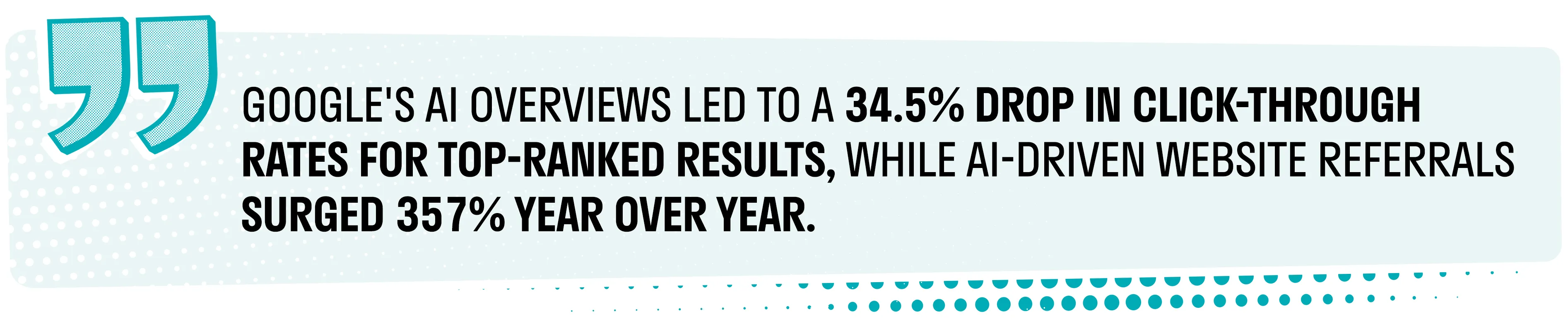
What does this mean for marketers and businesses? Google’s AI Overviews led to a 34.5% drop in click-through rates for top-ranked results, while AI-driven website referrals surged 357% year over year. The fundamentals of getting found haven’t changed; you still need to create helpful, authoritative content that serves your audience.
Let me break down what these terms actually mean, why they matter, and how Ridge Marketing approaches optimization in 2026.
Rather than being separate strategies, these are complementary layers. A well-optimized piece of content can succeed in all three areas simultaneously.
What is SEO?
SEO (Search Engine Optimization) is what we’ve been doing for decades: optimizing websites to improve search rankings. You create quality content, ensure technical soundness, build authority, and help search engines understand your pages. The goal is to drive organic traffic.
What is AEO?
AEO (Answer Engine Optimization) focuses on getting your content featured in direct answers, including featured snippets, voice assistant responses, and AI-generated summaries such as Google’s AI Overviews. Instead of just driving clicks, AEO aims for visibility in zero-click results, where users get their answers without leaving the search page.
What is GEO?
GEO (Generative Engine Optimization) takes this further. It’s about positioning your content so that generative AI platforms (ChatGPT, Google Gemini, Claude, Bing Chat) include and cite your content when synthesizing answers. When someone asks an AI a complex question, GEO helps ensure you’re one of the sources it references.
Think of it this way:
| SEO | provides the foundation to make sure your content can rank |
| AEO | ensures your content is formatted for answer-focused features |
| GEO | positions your content as a trusted source for AI platforms |
Are these really different? Not really. They’re evolutions of the same core practice.
Many experienced SEO professionals echo this view. As one industry veteran noted: “These new terms… we use them today to categorize changes we are seeing, but to me, this is all still SEO.” The proliferation of acronyms reflects new search behaviors, not fundamentally different strategies.
What Google Says
Google’s guidance on this is refreshingly straightforward: keep doing what you’ve been doing.
When Google introduced AI Overviews (part of their Search Generative Experience), they explicitly stated: “There are no additional requirements to appear in AI Overviews or AI Mode, nor other special optimizations necessary beyond general SEO best practices.”
Their core message? “Focus on people-first content,” Google advises. “The underpinnings of what Google has long advised carry across to these new experiences.” If your content is helpful, well-structured and crawlable, you’re already positioned for success in AI-driven search.
This aligns completely with our philosophy at Ridge: write great content, and the technical optimization will amplify it.
Practical Strategies for the AI Era

How do you become one of the few sources AI cites? Generative AI platforms typically reference only 2-7 sources per response, far fewer than Google’s traditional ten blue links.
While Google says “no special optimization is needed,” there are practical steps that improve your content’s performance in AI-driven search.
Structure Pages for AEO
Organize content with clear headings (H2, H3) that break topics into digestible sections. Use short paragraphs (2-4 sentences) and avoid long, unstructured blocks of text. Think of your headings as chapters that an AI can read independently.
Why it works: AI systems break content into chunks to evaluate relevance. Well-structured content makes this easier for both humans and machines.
Answer Questions Directly
Include FAQ sections or Q&A-style content. Lead with the answer in the first sentence, then provide supporting detail in 40-60 words.
Example:
Q: How long does it take to see AEO results?
A: Most businesses see initial AI citations within 2-3 months of implementing AEO strategies, with significant visibility improvements appearing within 6-12 months. Results depend on your existing SEO foundation, content quality and competitive landscape.
Why it works: This mirrors how people search and how AI prefers to output information. Featured snippets often pull these direct answers.
Use Lists, Tables and Bullet Points
Present information in formats that are easy to scan and reuse:
- Bullet lists for features or benefits
- Numbered lists for sequential steps
- Comparison tables for data
- Definition lists for terminology
Why it works: AI systems can confidently interpret and reproduce structured content. It’s easier for them to extract and cite.
Implement Schema Markup for AEO
Schema markup is structured data that helps search engines and AI understand your content. The most useful types for AEO are:
| Schema Type | Use For | Benefit |
|---|---|---|
| FAQPage | Q&A content | Eligibility for rich results and voice answers |
| HowTo | Step-by-step guides | Featured in AI instructions |
| Article | Blog posts, news | Better content classification |
| Organization | Company info | Enhanced brand entity recognition |
Implementation: Use JSON-LD format (Google’s preferred method) and add it to your page’s <head> section. Tools such as Google’s Structured Data Markup Helper or Schema.org generators can write the code for you.
Validation: Test your schema with Google’s Rich Results Test to ensure it’s error-free before publishing.
Provide Factual, Verifiable Information and Demonstrate Expertise
Include specific facts, statistics, dates and sources in your content. Link to authoritative references and cite your research. Research from Princeton found that adding authoritative citations increased AI visibility by 30-40%.

Show clear author bylines with credentials, updated publication dates and relevant experience. If you’re writing about technical topics, mention your qualifications. For business advice, reference your years of experience or client success stories.
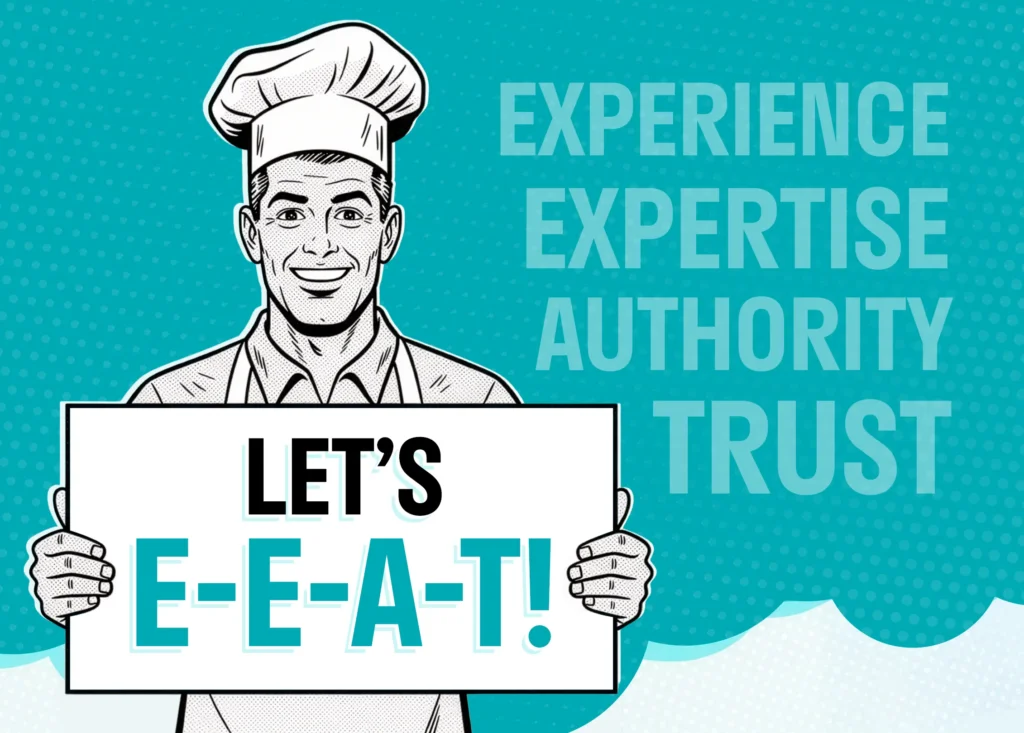
Why it works: AI systems prioritize factual, well-sourced information. When they can verify and attribute your data, they’re more likely to cite you as a trusted source. Adhering to Google’s E-E-A-T principle (Experience, Expertise, Authority, Trust) enables AI models to leverage the same authority signals that search algorithms use.
How to Measure Success
Success in the AI era requires tracking new metrics alongside traditional SEO KPIs. Research cited by Andreessen Horowitz found that only 12% of citations in AI assistants also rank in Google’s top 10. This means 88% of AI citations come from URLs that don’t appear in Google’s top results for the same queries. You could dominate traditional search rankings but be invisible in AI answers, or vice versa.

Here’s what to monitor:
Core AEO/GEO Metrics
AI Visibility Rate: The percentage of relevant AI queries where your brand appears in the answer. Test 20-50 core questions monthly across ChatGPT, Google Gemini and Bing Chat to track trends.
Citation Frequency: How often AI platforms cite your URL as a source. This is your “money metric” because citations drive high-intent, pre-qualified traffic. Track this using Search Console referrer data (look for traffic from AI platforms).
Featured Snippet Ownership: The percentage of target queries where your content appears in Google’s featured snippets. These feed into voice search and AI answers. Track in Semrush, Ahrefs or Google Search Console.
Schema Implementation Rate: The percentage of your key pages with proper structured data. Aim for 100% coverage on important content. Validate using Google’s Rich Results Test.
Business Impact Metrics
AI Referral Traffic: Visitors arriving from ChatGPT, Claude, Perplexity and other AI platforms. Set up custom segments in Google Analytics 4 to track these separately from organic search.
Engagement from AI Sources: Compare time on site, pages per session, and conversion rates for AI referral traffic versus traditional search. Studies show visitors referred by AI answers convert 4.4x better on average than regular search visitors, likely because the AI has pre-qualified the content in context.
Brand Search Lift: Monitor branded search volume to gauge AI-driven awareness. Users who encounter your brand in AI answers often search for you directly later.
Competitive Benchmarking
Track your “share of voice” in AI answers compared to competitors. If AI platforms mention three brands when answering industry questions, calculate what percentage belongs to you. An increasing share indicates successful AEO implementation.
How Ridge Approaches Optimization in 2026
Our strategy hasn’t fundamentally changed because we’ve always focused on creating content that genuinely helps our clients’ audiences.
Quality still wins. Low-quality content, clickbait and AI-generated fluff are even less likely to succeed now. Generative AI can summarize multiple sources. If your content is shallow, it gets ignored.
Technical SEO still matters. Fast load times, mobile optimization and proper indexing remain critical fundamentals. Many AI systems pull from search indexes, so if your technical SEO is weak, you won’t be in the pool of content they draw from.
User intent still drives everything. Understanding what your audience needs and delivering it clearly is the core of both traditional SEO and these new optimization approaches.

What we’ve added:
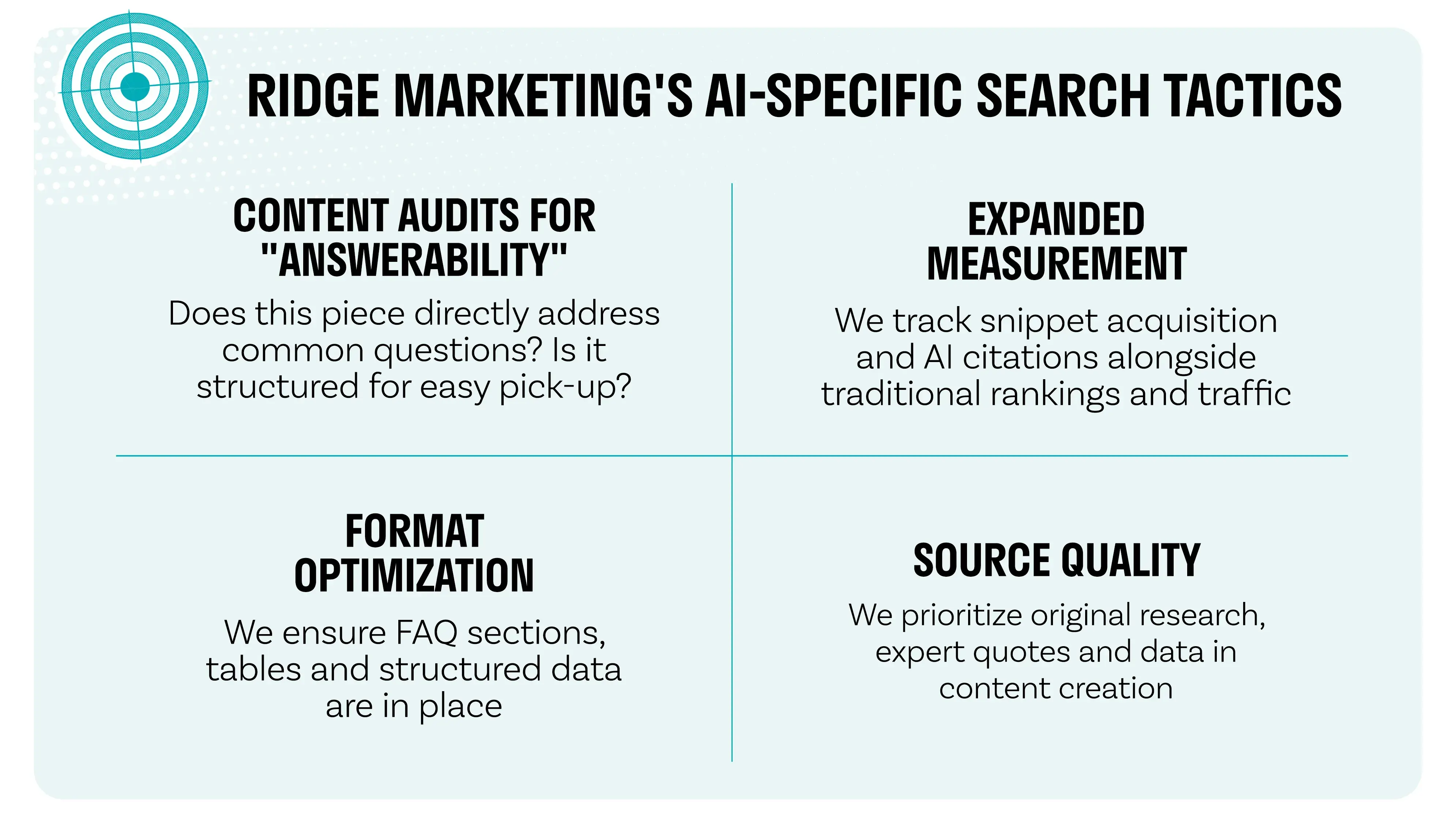
- Content audits for “answerability”: Does this piece directly address common questions? Is it structured for easy pick-up?
- Expanded measurement: We track snippet acquisition and AI citations alongside traditional rankings and traffic.
- Format optimization: We ensure FAQ sections, tables and structured data are in place.
- Source quality: We prioritize original research, expert quotes and data in content creation.
The Bottom Line
While AEO and GEO are helpful terms that describe new tactics for an evolving landscape, the fundamental objective remains unchanged: help your target audience find the information they need, ideally from you. What’s different is how that information gets delivered. It’s not just through blue links but also through featured snippets, voice answers and AI-generated responses.
If you’ve been creating helpful, authoritative, well-structured content, you’re already most of the way there. The “optimization” part is about ensuring content is formatted and presented in ways that both people and AI find immediately useful.
So yes, pay attention to AEO and GEO. Adapt your tactics. But don’t lose sight of what’s always worked: write great content that serves your audience, ensure it’s technically sound and build genuine authority in your space. That’s worked for 25 years of SEO, and it’ll work for whatever acronym comes next.
Need help ensuring your content performs well in both traditional search and AI-driven answers? Ridge Marketing develops comprehensive content strategies that balance creativity with technical optimization. Let’s talk about your SEO, AEO, and GEO approach.
Frequently Asked Questions About AEO and GEO
Can small businesses compete with AEO?
Yes. AEO can be a competitive advantage for small businesses. You can establish authority in specific niches more easily than large companies covering broad markets. Focus on answering specific questions in your area of expertise with genuine, detailed content. AI systems recognize authentic expertise and unique insights.
Should I stop focusing on SEO if I’m doing AEO?
No. SEO and AEO work together, not separately. Strong SEO provides the foundation for AEO success, and good rankings increase your chances of being selected for AI answers. Continue SEO best practices while implementing AEO-specific optimizations, such as Q&A formats and schema markup.
What tools do I need for AEO?
Start with free tools: Google Search Console (track impressions and snippets), Google’s Rich Results Test (validate schema) and AnswerThePublic (find common questions). For more advanced tracking, consider Semrush, Ahrefs or specialized AEO platforms that monitor AI citations. Many businesses see success with just the basics plus manual testing of AI platforms.
How do I optimize for voice search?
Use conversational, natural language and long-tail keywords that match how people speak. Structure content in Q&A format with concise answers (40-60 words). Focus on question-based headings such as “What is…”, “How to…”, and “Why does…”. Implement FAQ schema to increase eligibility for voice assistant answers.
How often should I update content for AEO?
AI systems favor fresh, current information. Review and update your key content quarterly, adding new data, examples or answers to emerging questions. Update publication dates when making substantial changes. Regular updates signal to AI that your content is maintained and trustworthy, increasing citation likelihood.